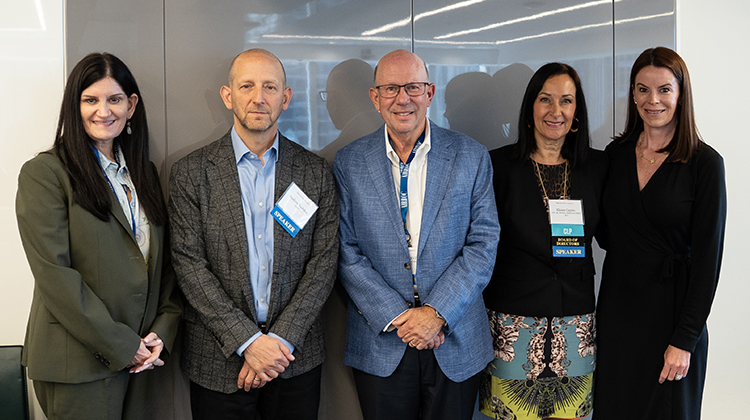
The AIRROC panel “Mediating Reinsurance Cases” addressed how mediation may or may not work in reinsurance. The moderator was Mark Gurevitz of MG Re Arbitrator and Mediator Services, and speakers were Andrew Nadolna, a JAMS mediator and former Global Head of Casualty Claims at AIG; Elaine Caprio, an arbitrator, mediator and Chief Re Officer for R&Q Re in Liquidation; Andrea Giannetta, Senior Vice President and Group Litigation Director at Enstar; and Kira Grahl, Head of P&C Reinsurance Claims for Swiss Re America.
The panel agreed that reinsurance disputes are specialized, relationship-driven, and technically dense. Grahl noted that parties may resist mediation when they doubt that a mediator can master the commercial realities, business impact, and reinsurance nuances. Giannetta added a simpler point: mediation is often “not top of mind.” Parties see an arbitration clause and go straight to arbitration, even though mediation may save substantial cost. And they often want a “black and white” answer to an issue, which arbitration provides.
Caprio identified the best candidates for mediation: “toxic relationship” cases, disputes where creative business solutions are preferable to a money award, matters without retrocessionaire complications, and cases not being pursued purely on principle or for a necessary precedential ruling. Giannetta added that mediation can help where one party has less reinsurance experience and needs a neutral to build trust in the process. And the parties felt that they and not a mediator should be the one to “bring senior management around” to the true value or strength of a case.
Timing was a major theme. Early mediation can work when issues are narrow or the economics favor speed, but reinsurers often need enough information from cedents before meaningful evaluation. Caprio warned against mandatory mediation clauses that become delay tactics and favored a flexible “mediation window” during arbitration. Look at the “mediation window:” the right time to use mediation, e.g., when the record is complete. Gurevitz has seen mediation inserted into an arbitration by the parties.
The panel also stressed mediator quality. A mediator must be neutral, prepared, persistent, empathetic, and willing to test assumptions without merely shuttling numbers. Nadolna described mediation as a process, not a single event, requiring pre-session planning, confidential and shared submissions, active listening, lawyer and client calls, and follow-up after an unsuccessful session. The mediator doesn’t always have to be an expert in reinsurance, especially if the amount at issue is small.
Gurevitz discussed the pros and cons of arbitrators mediating a case in arbitration.
To prepare for mediation, parties need to manage their own expectations, be flexible, and be prepared to feel uncomfortable while openly mediating the issues. Nadolna recommended that parties choreograph in advance the likely offers and counteroffers in the mediation, come in with concessions, etc.
Mediators need empathy, be willing to hear and understand each party’s positions, and find out the interests behind their positions to find a creative solution. Decision makers must be present and solution oriented. If parties reach a logjam, the mediator should thoroughly test the strength of their positions before the mediation is called, knowing that mediation is a continuing process and can always reconvene. And sometimes the parties may settle after and as a result of an unsuccessful session.
In successful cases, the mediation is structured with a thoughtful process, including the mediator having direct discussions with the lawyers and the parties and giving the parties a detailed risk analysis. Zoom has positively impacted the process; it’s too early to evaluate the impact of AI.
The takeaway was pragmatic: mediation will not replace arbitration, but it deserves a larger role. Used at the right time, with authority in the room and a mediator who understands the stakes, it can narrow issues, educate parties, preserve relationships, and sometimes achieve solutions arbitration cannot.

